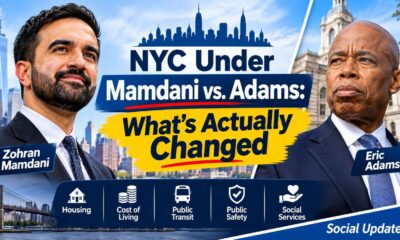

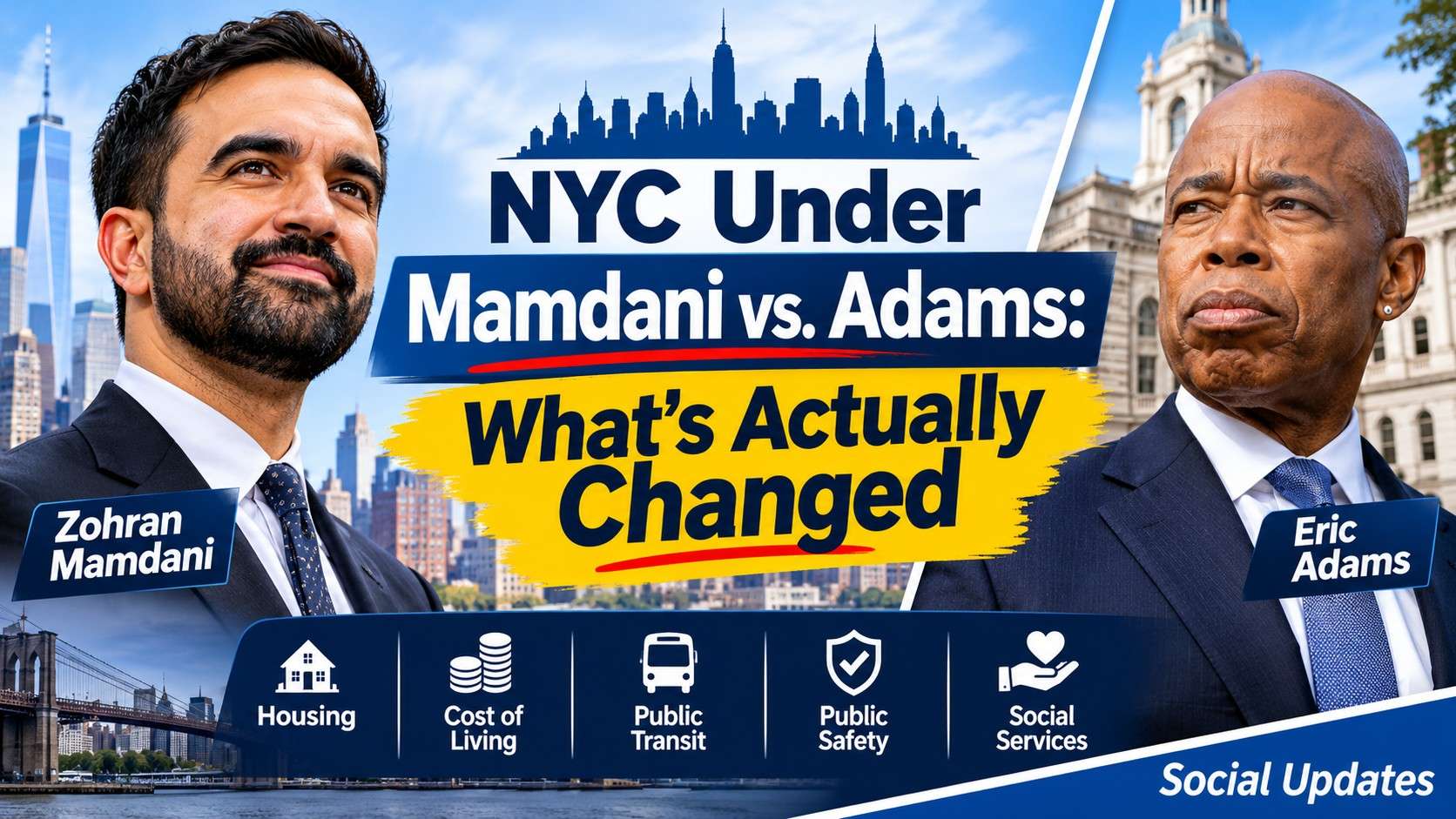
Comparing two mayoral administrations invites strong opinions, but the underlying data tells a more nuanced story than either side’s talking points usually suggest. Here’s a factual look at what’s genuinely different between New York City under Mamdani and under his predecessor, Eric Adams, and what’s actually a continuation of trends already underway.
Crime: A Continuing Trend, Not a Sudden Reversal
This is the most important, and most commonly misunderstood, part of the comparison. New York City’s crime decline didn’t begin with Mamdani; it was already well underway under Adams. By the end of his term, Adams reported that 2025 was shaping up to be the year with the lowest number of shootings recorded in city history.
Murder had declined 22%, and shootings had declined more than 40% since Adams took office in 2022. Adams’s NYPD seized more than 25,000 illegal guns over his four years in office.
What Mamdani inherited, in other words, was an already-improving public safety trajectory, not a crisis he single-handedly reversed. His administration’s 2026 numbers mark the lowest murders and shootings in recorded history for the first half of a year. They represent a continuation and further acceleration of a multi-year decline that began under Adams, not an isolated turnaround starting from a high point.
That said, it’s also fair to note a real distinction within the data. Shootings and murders fell substantially under Adams. But several other major crime categories, felony assault, robbery, and car theft among them, actually rose during parts of his term, complicating any simple “crime was worse under Adams” framing. Total crime, across all 34 tracked categories including quality-of-life offenses, increased in some Adams-era years even as the most violent crime categories fell.
You May Also Like: Who is Zohran Mamdani? NYC’s Mayor, Explained
Policing Strategy: Different Emphasis, Similar Underlying Tools
Both administrations have pointed to targeted, data-driven policing as central to their public safety results. They focused on getting illegal guns off the street. They also directed resources toward specific high-crime areas and repeat offenders. The genuine philosophical difference lies elsewhere. Mamdani has moved some functions away from the NYPD. For example, he shifted homelessness outreach toward other city agencies.
Initially, he proposed keeping the police headcount flat rather than expanding it, though he later reversed this position. This reflects his broader “whole-of-government” framing. He views public safety as extending beyond policing alone.
Adams, a former police captain, generally framed public safety more centrally around NYPD staffing and visible police presence. He added 1,200 new officer recruits in 2024 and directed additional officers onto subway platforms and trains.
Housing Policy: A Clear Point of Departure
This is one of the sharpest actual policy differences between the two administrations. Mamdani appointed a majority of the Rent Guidelines Board. This included its chair. He secured a 0% rent increase for stabilized units. These freezes apply to leases beginning in late 2026.
This fulfilled a specific campaign promise. Adams’s Rent Guidelines Board took a different approach. They approved rent increases during his term. This created a point of ongoing tension with tenant advocates throughout his mayoralty.
The dynamic on the CityFHEPS rental assistance program is more complicated than a simple reversal narrative. Adams resisted expanding the program. He vetoed related City Council legislation. He even sued the council after it overturned his veto.
Mamdani campaigned on fully implementing that expansion. However, he delivered a smaller version of it once in office. This partial fulfillment fell short of his own campaign commitment. Still, the final expansion went further than Adams was willing to go.
You May Also Like: Mamdani’s Signature Policies Explained: What’s Actually Happened
Affordability Initiatives: A New Emphasis Under Mamdani
Programs like the 2-K free childcare initiative, the Fair Fares transit discount expansion, and city-run grocery store proposals represent a distinctly different policy emphasis than the Adams administration’s priorities. This is centered more heavily on business development, tourism recovery, and public safety as core themes.
Whether these newer initiatives prove as durable and well-funded as intended remains an open question, given the funding uncertainties discussed in coverage of Mamdani’s first year.
Fiscal Approach: Different Rhetoric, Similar Constraints
Both administrations have faced real budget constraints. They were forced to make trade-offs between competing priorities. Mamdani has been vocal about what he describes as a structural fiscal imbalance. This imbalance exists between what New York City contributes to state revenue and what it receives back.
Both his and Adams’s administrations navigated multibillion-dollar budget gaps during their respective terms. This remains a recurring challenge for NYC mayors generally. It is not unique to either individual administration.
What This Comparison Doesn’t Settle
A factual comparison of policy and data doesn’t resolve the deeper political debate over which administration’s overall approach is more effective or desirable; that judgment depends on values and priorities that reasonable people weigh differently.
What the data does show clearly is that neither administration operated in isolation from the other. Mamdani inherited real, measurable momentum on public safety from Adams’s final years in office, while diverging sharply from Adams’s approach on housing policy and making a different set of trade-offs in balancing affordability initiatives against fiscal constraints.
Frequently Asked Questions
Did crime actually start declining under Mamdani, or was it already declining under Adams?
It was already declining under Adams; murders and shootings fell substantially during his term, with 2025 shaping up to be a record-low year for shootings before he left office. Mamdani’s 2026 numbers represent a continuation and further acceleration of that existing trend.
What’s the clearest policy difference between the two mayors?
Housing policy stands out most clearly: Mamdani secured a rent freeze for stabilized units through his Rent Guidelines Board appointments, while Adams’s board approved rent increases and he actively resisted expanding the CityFHEPS rental assistance program during his term.
Did Adams and Mamdani take different approaches to NYPD staffing?
Broadly, yes, Adams generally emphasized expanding police staffing and visible presence, while Mamdani campaigned on keeping headcount flat, though he later reversed that position before ultimately walking back a proposed officer increase in final budget talks.
Is one administration’s public safety record definitively better than the other’s?
The data shows real improvement continuing across both administrations on the most violent crime categories, while other crime categories moved in different directions at different points under each. A single “which was better” verdict depends heavily on which specific metrics and time periods are being compared.
You May Also Like: Mayor Mamdani’s First Year: NYC Crime Rates & Policy Changes


Contributer