
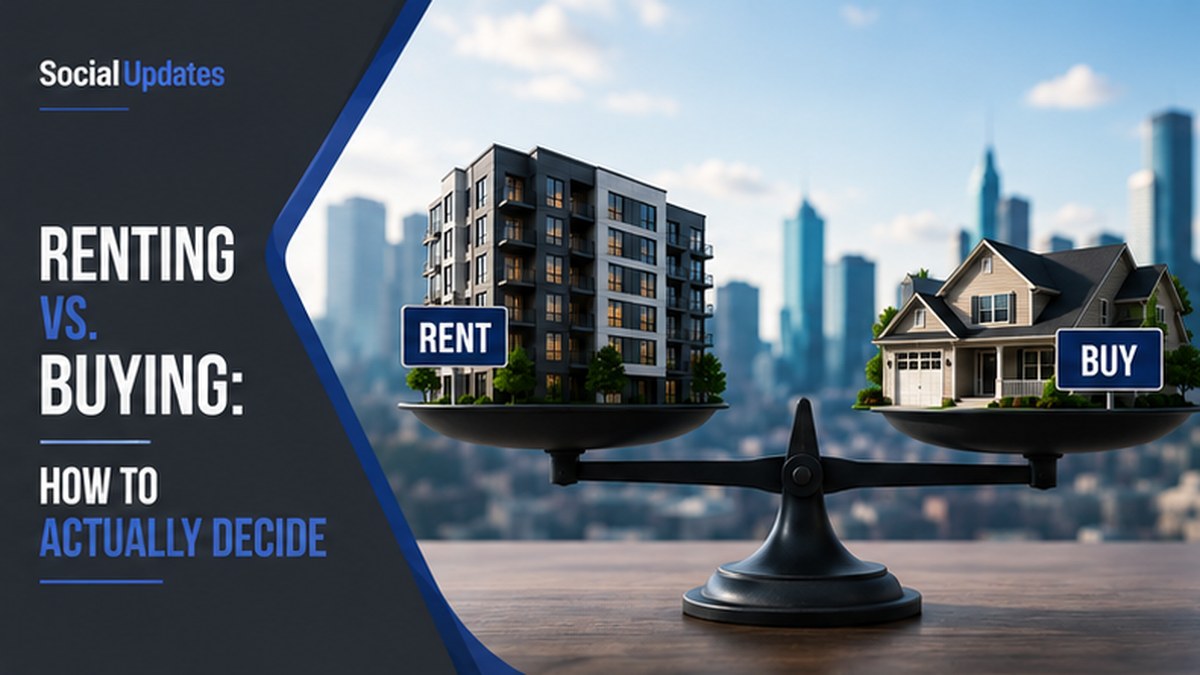
“Renting is throwing money away” and “buying is always a good investment” are both oversimplified and both are wrong often enough to be dangerous advice to follow blindly. The right answer depends on your specific numbers, timeline, and life situation, not a one-size-fits-all rule.
Here’s a practical framework to work through the decision yourself, rather than relying on generic advice from either side.
The Real Comparison Isn’t Rent vs. Mortgage
The most common mistake is comparing your current rent directly to a potential mortgage payment. That’s incomplete. Owning comes with costs renting doesn’t: property taxes, homeowners insurance, maintenance and repairs (often estimated at 1-2% of home value per year), closing costs, and potentially HOA fees.
A more honest comparison: total monthly cost of owning (mortgage + taxes + insurance + estimated maintenance) versus total monthly cost of renting (rent + renter’s insurance). Only then are you comparing like with like.
The 5-Year Rule of Thumb
A commonly cited guideline: buying tends to make more financial sense if you plan to stay in the home at least 5 years. This is because closing costs (typically 2-5% of the purchase price) and the early years of a mortgage, where most of your payment goes toward interest rather than equity, take time to “break even” against renting.
If there’s a real chance you’ll move within 2-3 years for work, relationships, or lifestyle reasons, renting is very often the financially safer choice, even if buying feels like the more “adult” decision.
What Buying Actually Builds and What It Doesn’t
Buying builds equity but slowly at first. In the early years of a typical mortgage, a large share of each payment goes toward interest, not principal, so equity builds up gradually rather than immediately. Home appreciation, when it happens, is also not guaranteed and varies significantly by location and market timing.
What buying reliably gives you that renting doesn’t: payment stability if you have a fixed-rate mortgage (your principal and interest won’t rise with the market, though taxes and insurance can), and the freedom to renovate or modify the space to your own preferences.
What renting reliably gives you that buying doesn’t: flexibility to relocate without selling an asset, no responsibility for major repairs (a new roof or HVAC system is the landlord’s cost, not yours), and typically lower upfront cash requirements.
Run Your Own Numbers
Before deciding, calculate these for your specific situation:
- Total monthly cost of owning (mortgage + taxes + insurance + 1% of home value annually for maintenance, divided by 12) vs. total monthly cost of renting.
- Upfront cash needed to buy down payment plus closing costs versus what that same amount could earn if invested instead.
- How long you realistically expect to stay in the home or area.
- Job and income stability: a large mortgage is a much bigger risk if your income is variable or uncertain.
There are free rent-vs-buy calculators from major financial sites that let you plug in your specific numbers rather than relying on rules of thumb alone; worth using once you have real figures for your market.
Questions to Ask Yourself Beyond the Math
The financial comparison matters, but it isn’t the whole picture:
How much do you value flexibility right now for career moves, relationship changes, or simply not being tied down?
How would you handle an unexpected $10,000 repair: a furnace, a roof, a foundation issue without it derailing your finances?
Is your local market currently favoring buyers or sellers? In markets where home prices are unusually high relative to local rents, the math tends to favor renting, even for people who plan to stay long-term.
Do you have an emergency fund separate from your down payment? Buying a home shouldn’t use up all your savings, leaving nothing for the inevitable unexpected costs of ownership.
When Renting Is Clearly the Better Choice
- You expect to move within the next 2-3 years, for work, relationships, or any other reason.
- Your local market has unusually high home prices relative to rents (a high price-to-rent ratio).
- You don’t have a stable emergency fund beyond a potential down payment.
- You value flexibility more than stability at this stage of life.
When Buying Is Clearly the Better Choice
- You’re confident you’ll stay in the home or area for 5+ years.
- Your monthly owning costs are comparable to or only modestly higher than renting in your market.
- You have a stable income and an emergency fund separate from your down payment.
- You want the ability to modify or renovate the space, or value the stability of a fixed housing payment.
A Middle Path: Renting Longer While Preparing to Buy
For people who aren’t ready to commit either way, treating the decision as a countdown rather than an immediate choice can help. This means renting deliberately for a set period, say, 2-3 years while building a down payment, stabilizing income, and researching target neighborhoods, rather than either rushing into a purchase or renting indefinitely without a plan.
During this period, automating savings toward a specific down payment goal, tracking local price-to-rent trends, and getting pre-approved for a mortgage can turn an open-ended question into a concrete plan with a clear decision point.
Frequently Asked Questions
Is it ever a bad time to buy, regardless of personal finances?
Yes, markets where home prices are unusually elevated relative to local rents (“high price-to-rent ratio”) can make buying a worse deal even for financially secure buyers, simply because you’re paying a premium the market hasn’t justified yet.
How much should I have saved before considering buying?
Beyond your down payment and closing costs, financial advisors commonly recommend keeping a separate emergency fund covering 3-6 months of expenses, since a home doesn’t provide liquid cash in an emergency the way savings do.
Does renting really mean I’m “throwing money away”?
Not necessarily. Renting pays for housing and flexibility, the same way buying pays for housing and equity; neither is inherently wasteful, and the better choice depends on your specific timeline and numbers.
What’s a price-to-rent ratio, and how do I find it for my area?
It’s the ratio of median home price to median annual rent in a given area. A lower ratio generally favors buying; a higher one favors renting. Several real estate data sites publish this by city and can help you see where your market currently stands.
You May Also Like: How to Pack a Carry-On for a Week-Long Trip


Contributer